


Billionaire fortunes in India grew by Rs 2200 crore a day last year as poorest remained in debt
- By NA
- 21 Jan, 2019
Billionaire fortunes in India increased by 35 percent last year – Rs 2200 crore a day - while 13.6 crore Indians who make up the poorest 10 percent of the country continued to remain in debt since 2004, a new report by Oxfam revealed today.
Globally, billionaire fortunes increased by 12 percent last year – $2.5 billion a day - while the 3.8 billion people who make up the poorest half of humanity saw their wealth decline by 11 percent.
The report is being launched as political and business leaders gather for the World Economic Forum in Davos, Switzerland.
‘Public Good or Private Wealth’ shows the growing gap between rich and poor is undermining the fight against poverty, damaging our economies and fuelling public anger across the globe. It reveals how governments are exacerbating inequality by underfunding public services, such as healthcare and education, on the one hand, while under taxing corporations and the wealthy, and failing to clamp down on tax dodging, on the other. It also finds that women and girls are hardest hit by rising economic inequality.
Amitabh Behar, CEO, Oxfam India said:
" It is morally outrageous that a few wealthy individuals are amassing a growing share of India’s wealth while the poor are struggling to eat their next meal or pay for their child’s medicines. If this obscene inequality between the top 1 percent and the rest of India continues then it will lead to a complete collapse of the social and democratic structure of this country.”
Winnie Byanyima, Executive Director of Oxfam International, said:
“The size of your bank account should not dictate how many years your children spend in school, or how long you live – yet this is the reality in too many countries across the globe. While corporations and the super-rich enjoy low tax bills, millions of girls are denied a decent education and women are dying for lack of maternity care.”
The report reveals India added 18 new billionaires last year raising the total number of billionaires to 119. Their wealth crossed the US$400 billion (INR 28000 billion) mark for the first time. It rose from US$325.5 billion (INR 22725 billion) in 2017 to US$440.1 billion (INR 30807 billion) in 2018. This is the single largest annual increase since the 2008 Global Financial Crisis.
- Getting the richest one percent in India to pay just 0.5 percent extra tax on their wealth could raise enough money to increase government spending on heath by 50 percent.
- Last year, wealth of top 1 percent in India increased by 39 percent whereas wealth of bottom 50 percent increased at a dismal 3 percent.
- Globally, tax rates for wealthy individuals and corporations have also been cut dramatically. For example, the top rate of personal income tax in rich countries fell from 62 percent in 1970 to just 38 percent in 2013. The average rate in poor countries is just 28 percent.
- India’s combined revenue and capital expenditure of the Centre and State for Medical & Public Health, Sanitation & Water Supply is Rs 2,08,166 crore (INR 2082 billion), less than the wealth of India’s richest billionaire Mukesh Ambani at Rs 2,80,700 crore (INR 2807 billion).
While billionaire wealth soars, public services are suffering from chronic underfunding or being outsourced to private companies that exclude the poorest people. In many countries including India, a decent education or quality healthcare has become a luxury only the rich can afford. Children from poor families in India are three times more likely to die before their first birthday than children from rich families.
Cutting taxes on wealth predominantly benefits men who own 50 percent more wealth than women globally, and control over 86 percent of corporations.
Conversely, when public services are neglected poor women and girls suffer most. Girls are pulled out of school first when the money isn’t available to pay fees, and women clock up hours of unpaid work looking after sick relatives when healthcare systems fail. Oxfam estimates that if all the unpaid care work carried out by women across the globe was done by a single company it would have an annual turnover of $10 trillion – 43 times that of Apple, the world’s biggest company.
“Economic inequality plagued by caste, class, gender and religion needs to be tackled on a war-footing. Government must now deliver real change by ensuring that the super-rich and corporations pay their fair share of tax and invest this money to strengthen public healthcare and education. Governments can build a brighter future for everyone – not just a privileged few,” said Behar.
Notes to editors
The report, report summary, the methodology document explaining how Oxfam calculated the figures, and the data set is available on request. You can also find the link to the India specific summary here.
Oxfam’s calculations are based on the most up to date, comprehensive data sources available. Figures on the share of wealth owned by the poorest half of humanity come from Credit Suisse Wealth Databook and relate to the period June 2017 – June 2018. Figures on the very richest in society are based on more detailed data from the Annual Forbes ‘Billionaires List’ and relates to the period March 2017 - March 2018.
Oxfam is proud to be part of the Fight Inequality Alliance - a coalition of social movements, environmental groups, women’s rights groups, trade unions and non-governmental organizations. The Alliance is organizing events in over 30 countries from 18-25 January, around the same time as the WEF in Davos, but will be calling on their leaders to listen to ordinary people's demands and solutions to dealing with inequality - and not to the elites at Davos. For more information please visit www.fightinequality.org/
For Media queries please contact
Himanshi Matta, 8860182310, himanshi@oxfamindia.org
Recent News
Related Stories
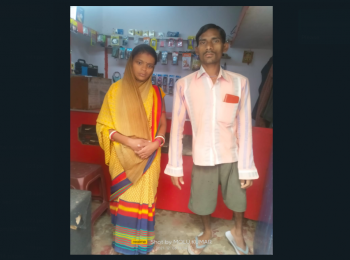
06 Dec, 2021
Nalanda, Bihar
Hope For Small Business Owners
Under Project Utthan, Sangita and Jitendra were provided with Rs 12,000, with which the couple were able to purchase a power supply booster, a heating machine for touch-screen cell phones, a mobile repairing pad and a revolving roller chair. All this has helped them boost their income by Rs 4,000 per month and they can keep their shop open longer than they used to.
Read More
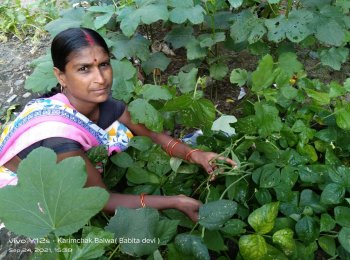
04 Dec, 2021
Nalanda, Bihar
Babita Devi: Becoming Self Reliant through Kitchen Garden
After looking into the socio-economic conditions of Babita Devi’s family, Project Utthan supported them by helping her to develop a kitchen garden. Babita Devi was provided with training in various forms of kitchen gardening, its design and layout, and taught the significance of the produce for nutrition and livelihood. She was also supported with seed kits for the Kharif season and accessible gardening tools.
Read More
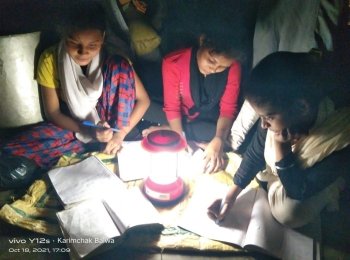
20 Nov, 2021
Nalanda, Bihar
Solar Lamps Light Up Futures
A solar lamp for Rakhi means she can study to become an IPS officer! The distribution of solar lights helped in not just overcoming the disruption in studies, it also aided in the reduction of the district’s carbon foot print. Oxfam India-HDFC project—UTTHAN—has been working in 15 villages in Nalanda since July 2020. HDFC’s CSR initiative Parivartan aims to ‘Create Sustainable Communities’ by enhancing sustainable livelihood options and improving access to essential services, especially of women and girls, from the most marginalised and vulnerable communities.
Read More
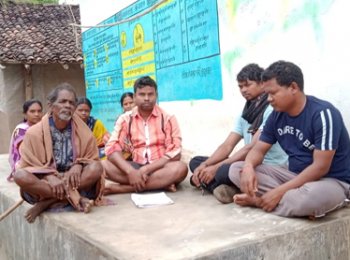
13 Nov, 2021
Bargarh, Odisha
Parents Pushback Against School Closure In Odisha
The School Management Committee of Brahmantal school hasn’t taken it lying down. Supported by the Odisha RTE Forum, they are pushing back against the decision because they realise the effort behind getting a 96% enrolment and the impact of quality education.
Read More
