


HEALTH AND EDUCATION CONTINUES TO FIND NO PRIORITY IN THE UNION BUDGET
- By Akshay Atmaram Tarfe
- 01 Feb, 2023
February 1, 2023; New Delhi: The Union Budget has missed yet another opportunity in addressing the growing inequality in the country. The allocation for key social sector spendings like health and education continued to remain abysmally low in the Union Budget. Oxfam India disappointedly notes that despite high inequality, the Union Budget has announced tax cuts for the people from the highest income slab.
This year, the Ministry of Health and Family Welfare and AYUSH has been allotted INR 92,802.5 crores, which is an increase of 13.2 per cent from the last year’s Budget. Yet, the Union Government spending on health is now only a meagre 2.06 per cent of the total Union Budget which is less than half percent (0.35 per cent) of India’s GDP. The Union Government meanwhile has allocated an amount of INR 1,12,899 crore to the Ministry of Education. Though it is an increase of 13 per cent from FY 2022-23, this constitutes only 2.5 per cent of the total Union Budget. This makes the Union Government expenditure on education only 0.41 per cent of India’s GDP.
The Mahatma Gandhi National Rural Employment Guarantee Program (MGNREGA), a scheme that was crucial in providing assistance to the poor has also seen a cut in Budget allocation. During COVID-19 pandemic, MGNREGA protected most vulnerable households through employment opportunities. The Union Government’s MGNREGA budget reduction ignores socio-economic realities of the country where people desperately need employment guarantee. MGNREGA received only INR 60,000 crores for FY 2023-24, a 30 percent decrease from FY 2022-23. During the last year, the scheme received an allocation of INR 89,400 Cr (RE).
“While the poor and marginalised in the country continue to suffer a health, education, cost of living and climate crisis, the Finance Minister's Union Budget unfortunately offers no relief. Instead, the Budget provides further tax cuts and incentives to the rich in the country. Inadequate allocation in the health and education sector runs the risk of depriving the socio-economically marginalised populations from good-quality education and healthcare. After the COVID-19 pandemic, the Union Finance Minister had a historic opportunity to reset our economy to address the obscene inequality being witnessed in the country. Sadly, this has not happened. We urge the Union Government to change the track and immediately enhance the budgetary allocation of the health sector to 2.5 per cent of GDP, as envisaged in the National Health Policy, to reinvigorate the public healthcare system. The Union Government must also enhance the budgetary allocation for education to the global benchmark of 6 per cent of GDP, as also committed in the National Education Policy,” said Amitabh Behar, CEO, Oxfam India.
*Note to the editor: All figures are Revised Estimates (RE) from the Union Budget 2022-23.
For any query, please reach out to - abhirr@oxfamindia.org
About Oxfam India
Oxfam India is a movement of people working to end discrimination and create a free and just society. We work to ensure that Adivasis, Dalits, Muslims, and women and girls have safe violence-free lives with freedom to speak their minds, equal opportunities to realize their rights, and a discrimination-free future.
📢Oxfam India is now on Telegram. Click here to join our Telegram channel and stay tuned to the latest updates and insights on social and development issues.
Recent News
Related Stories
15 Aug, 2021
Tumkur, Karnataka
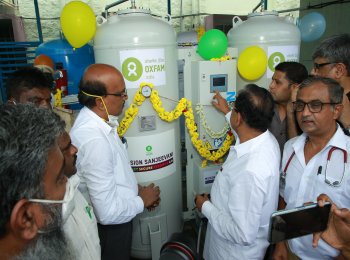
Oxfam India’s First Oxygen Plant in Tumkur
The 300 LPM Oxygen plant, set up under Oxfam India’s COVID-19 response ‘Mission Sanjeevani’, at the 80-bed government hospital at Koratagere in Tumkur in Karnataka will cater to people from 46 surrounding villages. Tumkur MLA, Dalit Leader and former deputy chief minister of Karnataka, G Parameshwara inaugurated the Oxygen plant on 26 July 2021.
Read More
02 Aug, 2021
New Delhi
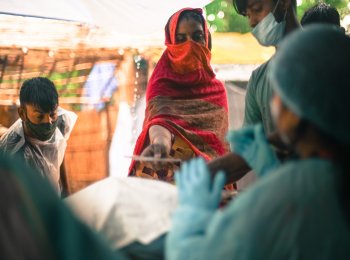
Delivering Hope and Dignity to Refugees
Oxfam India has been supporting communities worst affected by the pandemic, across India, for over a year now. At the heart of our response are communities already living on the margins such as daily wage workers, transgender communities, informal sector workers and differently abled people. We partnered with HAI to extend our support to refugees from Pakistan living in Delhi.
Read More
07 Jul, 2021
Assam
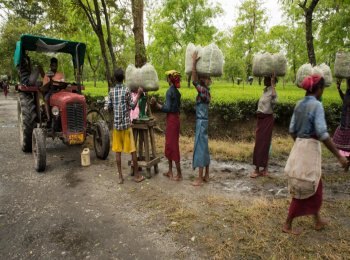
Labour Codes Training for Assam Tea Garden Workers
The Labour Codes will have significant impacts on the informal sector workers including the tea garden workers. A need was thus felt to train the workers around these Codes. The existing Plantation Labor Act, 1951 which used to govern the tea industry will be subsumed under these Codes. Different aspects of the Act will now feature in these four codes. In the above context, Oxfam India in collaboration with Centre for Workers’ Management initiated a training programme for workers across seven districts of Assam, during the month of June.
Read More
13 Apr, 2021
Sitamarhi, Bihar
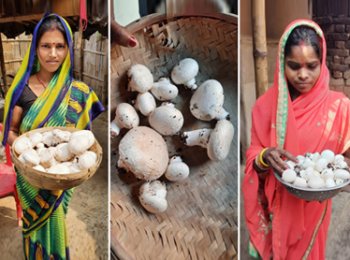
Mushroom Cultivation Makes Communities Resilience
Oxfam India has been working with these communities through its disaster risk reduction programme since 2012. It was in 2017 that it finally started its livelihood intervention programme — mushroom cultivation and vermicomposting — with the women from the Musahar community. This proved useful during the lockdown in 2020.
Read More
