


India Needs a Vaccine That is For People and Not for Profit, Says Oxfam India
- By Oxfam India
- 05 May, 2021

"Government needs to move beyond profit-making strategies and save lives," adds CEO Amitabh Behar
Oxfam India has been adapting its crisis response to the ongoing pandemic in order to help migrant workers, women in crisis and underserved citizens. The second wave of COVID-19 has however debilitated the country’s health infrastructure and caused an unprecedented humanitarian crisis. CEO Amitabh Behar is worried that during this time of need, a potentially life-saving vaccination dose may not even reach all the citizens who need it.
He cites the WHO Chief, Tedros Adhanom Ghebreyesus’ comment who recently said, "We need countries and companies that control the resources that could save lives, to share." Says Behar, “The keyword here is ‘share.’ We live in a country of over 1361 million people and yet two active vaccines are expected to serve every citizen even though they are being patented and controlled only by the pharma companies that created them. This discrepancy between need and supply is caused by limited dosage production, which in turn also ramps up costs. What is problematic is the cost flexibility given to state governments and private buyers, which will leave the door open for middlemen and increase the cost of a vaccine that is needed by millions during this crisis.
By May 1, close to 600 million more Indians needed to be vaccinated. How will the country meet this demand? Will states and hospitals end up waging a price war as they compete with each other for a limited stock of the vaccine?
Behar says, “An acute shortage of vaccine doses can only spell doom and it is critical that these vaccines be free and available for everyone. The government needs to adopt a ‘People's Vaccine Plan’ that serves all citizens and takes profiteering out of the equation. India needs a vaccine that is for people and not for profit and a vaccination module that is not only for those who have spending power.”
He finds it problematic that no cap has been placed on the vaccine price and individual companies are now free to declare their own costs. He adds, “People are expected to pay over Rs 2400 for two doses in the public system and Rs 3600 in a private hospital. These prices seem to have stemmed out of a producer declared monopoly price and not one that is “discovered” through competitive price. The rate fixed for India, equivalent to USD 5.25 also seems to be targeting the upper-middle-income groups in a country that is classified as a lower-middle-income country. Comparative data suggest that most of India will be paying more than the richest countries of the world despite producing these vaccines domestically. Why is there such a lack of transparency in the fixation of these rates?”
With India stepping into Phase 3 of its vaccination drive, the centre has distanced itself from the responsibility of making the vaccine affordable and passed on major financial burdens to states that are not equipped to handle them in the middle of the pandemic. This decision to create two vaccine supply streams—for the centre and the states—marks a deviation from this historic precedent and is an abdication of responsibility by the centre. This shift is disconcerting because India had initially declared that the vaccine would be free thanks to the PM CARES fund and other central funding systems. This would suggest that the government is walking back from its commitment and calls into question how the states find the resources, make necessary procurements and put in place modalities of distribution.
Oxfam India recommends a few steps that can make the vaccine accessible for all:
- Create a Peoples’ Vaccine Alliance’s (PVA) where the vaccine is purchased at true cost prices and provided free of charge to people.
- Implement fair allocation of the vaccine, which prioritises health workers and other at-risk groups. The current prioritisation of vulnerable groups for which the central government has responsibility includes healthcare workers, frontline workers and those above 45.
- Alternative options of vaccination of the vulnerable, including door-to-door vaccination, must be adequately explored. This strategy has been the backbone of India’s successful polio vaccination drive.
- Announce a detailed and transparent vaccine policy arrived upon in consultation with the states and India’s citizens at large that does not compromise India’s commitment to a free vaccine for all.
- Large scale procurement by the Central Government must be undertaken at regulated prices and with a transparent allocation scheme to ensure equity across states. There should be decentralised local government-driven strategies to ensure equitable access across economic classes.
- Continue prioritising the vulnerable during the course of the roll-out, prioritising those with co-morbidities or in at-risk occupations while gradually expanding the universalisation of the vaccine.
- Put in place, processes of regulation of vaccine prices and address profiteering by Pharma companies during the pandemic.
As a second wave of the pandemic devastates the livelihoods of much of India, a substantial share of the country's population will potentially be priced out of the vaccine without a universal free vaccination scheme to fall back on, says Behar and concludes, "Life chances of all Indians are no longer equal. Any vaccination strategy, which is less inclusive, affordable and accessible, will put all of India's citizens at risk. Vaccines are global public goods and it is the constitutional responsibility of the Indian State to provide them for free to everyone. 'Right to Health' flows directly from Article 21 of the Indian Constitution, and right to free vaccines is a sub-set of it.”
Recent News
Inequality Kills: India Supplement 2022
17 Jan, 2022
FCRA RENEWAL DENIED
02 Jan, 2022
Inter-State Women Leaders Convention
17 Dec, 2021
#SorryThankYouTataByeBye to Patriarchy
29 Nov, 2021
Patients Rights and Inequality in Vaccine Survey
23 Nov, 2021
Chhattisgarh CM Launches Gender Curriculum
15 Nov, 2021
Related Stories

28 Jun, 2023
Kalahandi, Odisha
The All-Rounder Women Farmers of Talnuagaon
The women farmers of the Ma Saraswati SHG—who run the Farmer Field School in Talnuagaon in Manikera GP—sell saplings and vegetables, provide irrigation solutions to farmers who were otherwise restricted only to the Kharif season, and produce their own organic fertiliser. The FFS has been set up under Project Utthan—an Oxfam India-HDFC Bank’s HRDP initiative.
Read More
27 Apr, 2023
Koraput, Odisha
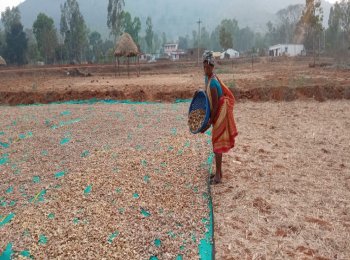
The Ginger Women of Koraput
A group of women farmers in the Pottangi and Semiliguda blocks of Odisha’s Koraput district are marketing ginger and doing a good job of it! Here small farmers rely on tuber crops for their income and sustainability. However, marketing these crops has been a major challenge. Oxfam India partnered with Prastutee to initiate livelihood initiatives with support from the Sita Devi Malhotra Charitable (SDMC) Trust to address these issues.
Read More
26 Apr, 2023
Sitamarhi, Bihar
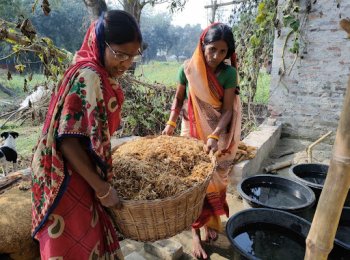
Spawning A Success Story In Parsauni Village
The Jeevan Jyoti Mushroom Utpadak Samuh consisting primarily of women from marginalised communities has made women entrepreneurs out of those women who once found it extremely difficult to make ends meet. Now they are nurturing business expansion plans, thanks to Oxfam India-HDFC Bank project Project Utthan.
Read More
17 Apr, 2023
Sitamarhi, Bihar
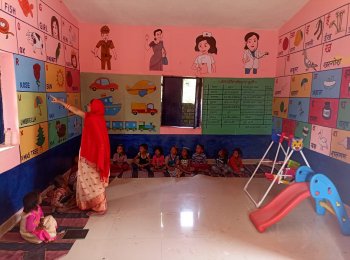
Anganwadi Centre No.115 Is Now A Model Centre
Project Utthan has had a significant impact on Anganwadi Centre No.115. Attendance has increased, and children now spend more time in the Centre; they are showing keen interest in learning with the new pictorial paintings and age-appropriate toys. Sushma is proud of her new renovated AWC. In fact, Sushma's presentations about the renovated AWC at various ICDS platforms have successfully drawn the attention of officials to the potential of replicating this model in other AWCs.
Read More
