


The Inequality Virus—India Supplement 2021
- By Savvy Soumya Misra & Tejas Patel
- 22 Jan, 2021
Wealth of Indian billionaires go up during lockdown while millions lost livelihoods
India’s 100 billionaires have seen their fortunes increase by Rs 12,97,822 crores since March 2020, enough to give every one of the 138 million poorest Indian people a cheque for Rs 94,045 each.
It would take an unskilled worker 10,000 years to make what Mukesh Ambani made in an hour during the pandemic and 3 years to make what he made in a second, finds the latest India supplement of the Oxfam report “The Inequality Virus”—the latest report being released on the opening day of the WorldEconomic Forum’s ‘Davos Dialogues’.
The Coronavirus pandemic has been the world’s worst public health crisis in a hundred years. It triggered an economic crisis comparable in scale only with the Great Depression of the 1930s.
The new global survey of 295 economists from 79 countries, commissioned by Oxfam, reveals that 87 percent of respondents, including Jeffrey Sachs, Jayati Ghosh and Gabriel Zucman, expect an ‘increase’ or a ‘major increase’ in income inequality in their country as a result of the pandemic.
“The report shows how the rigged economic system is enabling a super-rich elite to amass wealth in the middle of the worst recession and the biggest economic crisis in the history of independent India, while millions of people are struggling to make ends meet. It reveals how the pandemic is deepening long-standing economic, caste, ethnic, and gender divides,” Oxfam India CEO Amitabh Behar said.
“While the Coronavirus was being touted as a great equaliser in the beginning, it laid bare the stark inequalities inherent in the society soon after the lockdown was imposed,” Behar added.
India introduced one of the earliest and most stringent lockdowns in the face of the pandemic; the enforcement of the lockdown brought the economy to a standstill triggering unemployment, hunger, distress migration and untold hardship in its wake. The rich were able to escape the pandemic’s worst impact; and while the white- collar workers isolated themselves and worked from home, a majority of the not-so-fortunate Indians lost their livelihood.
The report notes that billionaires such as Mukesh Ambani, Gautam Adani, Shiv Nadar, Cyrus Poonawalla, Uday Kotak, Azim Premji, Sunil Mittal, Radhakrishan Damani, Kumar Manglam Birla and Laxmi Mittal working in sectors like coal, oil, telecom, medicines, pharmaceuticals, education, and retails increased their wealth exponentially since March 2020 when India announced world’s biggest COVID-19 lockdown and economy came to standstill. On the other hand, data has shown that 170,000 people lost their jobs every hour in the month of April 20201.
Findings of the report’s Davos India Supplement show:
- Rich got richer: Data shows what Ambani earned during the pandemic would keep the 40 crore informal workers that are at risk of falling into poverty due to COVID-19 above the poverty line for at least 5 months.
The wealth of Indian billionaires increased by 35 percent during the lockdown and by 90 percent since 2009 to USD 422.9 billion ranking India, sixth in the world after US, China, Germany, Russia and France. In fact, the increase in wealth of the top 11 billionaires of India during the pandemic could sustain the NREGS scheme for 10 years or the health ministry for 10 years.
- Informal workers worst hit: Out of a total 122 million who lost their jobs 75 percent, which accounts for 92 million jobs, were lost in the informal sector.
The mass exodus on foot triggered by the sudden lockdown & the inhuman beating, disinfection and quarantine conditions the informal workers were subjected to turned a health emergency into a humanitarian crisis. Over 300 informal workers died due to the lockdown, with reasons ranging from starvation, suicides, exhaustion, road and rail accidents, police brutality and denial of timely medical care. The National Human Rights Commission recorded over 2582 cases of human rights violation as early as in the month of April 2020.
- Education on hold: The long disruption of schooling risked doubling the rate of out of school, especially among the poor. Only 4 percent of rural households had a computer and less than 15 percent rural households had an internet connection.
The digital mode of delivering education has proven exclusionary. Girls are most likely to bear the brunt as only 15.5% rural females could either use a computer or the internet. While the burden of ensuring children continuing their education fell on individual households with those financially better off and educated benefitting, this period saw an exponential growth of private providers such as BYJU’s (currently valued at USD 10.8 billion) and Unacademy (valued at USD 1.45 billion).
- Health Inequalities: Only 6 percent of the poorest 20 percent has access to non-shared sources of improved sanitation, compared to 93.4 percent of the top 20 percent. 59.6 percent of India’s population lives in a room or less.
This meant that facilities to wash hands and maintaining distance, essential to prevent the spread of Coronavirus, was impossible for a majority of the population. Pregnant women belonging to poor families were often left unassisted as most public health care institutions were turned into COVID-19 testing facilities and hospitals. The urgent need for healthcare resulted in massive profiteering from many private health establishments and while the government did take steps to make COVID-19 services affordable by including them under Ayushman Bharat-PMJAY, the scheme only covered BPL population leaving out the uninsured poor and the Middle Class.
- Women bear the burden: 17 million women lost their job in April 2020; Unemployment for women rose by 15 percent from a pre-lockdown level of 18 percent.
This increase in unemployment of women can result in a loss to India’s GDP of about 8% or USD 218 billion. In addition, the total time spent in both paid and unpaid activities by women has risen with the increase in the workload as a result of being stuck at homes. Women have been working longer hours and simultaneously managing the daily chores of the household, the educational needs of the children and care for all members of the family. The work-from-home culture has also blurred the lines between working hours and personal downtime.
- Rise in Violence Against Women during Lockdown: The National Commission for Women (NCW) received 1477 complaints of domestic violence from women between March 25 and May 31, 2020 alone.
Economic hardships and growing anxiety during emergencies often fuel violent and abusive relationships directed towards women and the pandemic has been no exception. This has unfortunately led to an increase in cases of domestic violence. Locked in their homes with their abuser, the numbers saw a spike in cases. As of November 30, 2020, cases of domestic violence stand at 4687 in 2020 compared to 2960 in 2019—a 58% rise. The highest number of cases were from Uttar Pradesh (1576), followed by Delhi (906) and Bihar (265).
“The pandemic has shaken the world to its very core. It has exposed the fault lines in our societies and economies but has also paved a way for transformative policies for a just and equal world. Newer and creative ways of catering to the needs of the masses is possible if governments are committed to the needs of its people. It is time for Government of India to take specific and concrete actions that will build a better future. We can build a future that is led by citizens’ voices who seek a more equal and just future,” Amitabh Behar said.
The COVID-19 crisis must be a turning point in the taxation of the richest individuals and big corporations. Progressive taxation of the richest members of the society must be the cornerstone of any equitable recovery from the crisis,” Behar added.
“There is an urgent need to enhance Health’s budgetary allocation to the tune of 2.5 percent of GDP to reinvigorate the public health system, reduce out of pocket expenditure and strengthen health prevention and promotion.”
India has the world’s fourth lowest health budget in terms of its share of government expenditure. If India’s top 11 billionaires are taxed at just 1% on the increase in their wealth during the pandemic, it will be enough to increase the allocation of Jan Aushadi Scheme by 140 times, which provides affordable medicines to the poor and marginalized.
The COVID-19 pandemic induced crisis has put the future of young people at risk, as too many are foregoing or losing access to education, especially girls and other economically and socially excluded groups. There is an urgent need to increase–or at least maintain–public education expenditure, in line with its commitments made as part of the 2020 Global Education Meeting declaration.
Notes to Editors
During the week of 25 January, the World Economic Forum (WEF) will digitally convene the ‘Davos Dialogues’, where key global leaders will share their views on the state of the world in 2021.
Oxfam’s calculations are based on the most up-to-date and comprehensive data sources available. Figures on the very richest in society come from Forbes’ 2020 Billionaires List. Because data on wealth was very volatile in 2020, the Credit Suisse Research Institute has delayed the release of its annual report on the wealth of humanity until spring 2021. This means that we have not been able to compare the wealth of billionaires to that of the bottom half of humanity as in previous years.
According to Forbes the 10 richest people as of December 31st, 2020, had seen their fortunes rise $540 billion dollars since the 18 March 2020. The 10 richest men were listed as: Jeff Bezos, Elon Musk, Bernard Arnault and family, Bill Gates, Mark Zuckerberg, Larry Ellison, Warren Buffett, Zhong Shanshan, Larry Page, and Mukesh Ambani.
The World Bank has simulated what the impact of an increase in inequality in almost every country at once would mean for global poverty. The Bank finds that if inequality (measured by the Gini coefficient) increases by 2 percentage points annually and global per capita GDP growth contracts by 8 percent, 501 million more people will still be living on less than $5.50 a day in 2030 compared with a scenario where there is no increase in inequality. As a result, global poverty levels would be higher in 2030 than they were before the pandemic struck, with 3.4 billion people still living on less than $5.50 a day. This is the Bank’s worst-case scenario, however projections for economic contraction across most of the developing world are in line with this scenario. In the World Economic Outlook (October 2020), the International Monetary Fund’s worst-case scenario does not see GDP returning to pre-crisis levels until the end of 2022. The OECD has warned this will lead to long-term increases in inequality unless action is taken.
Oxfam calculated that 112 million fewer women would be at risk of losing their jobs or income if men and women were equally represented in low-paid, precarious professions that have been most impacted by the COVID-19 crisis based on an ILO policy brief published in July 2020.
For Hindi PR, click here.
For more contact:
Savvy Soumya Misra: savvy@oxfamindia.org
Tejas Patel: tejas@oxfamindia.org
📢Oxfam India is now on Telegram. Click here to join our Telegram channel and stay tuned to the latest updates and insights on social and development issues.
Recent News
Inequality Kills: India Supplement 2022
17 Jan, 2022
FCRA RENEWAL DENIED
02 Jan, 2022
Inter-State Women Leaders Convention
17 Dec, 2021
#SorryThankYouTataByeBye to Patriarchy
29 Nov, 2021
Patients Rights and Inequality in Vaccine Survey
23 Nov, 2021
Chhattisgarh CM Launches Gender Curriculum
15 Nov, 2021
Related Stories

28 Jun, 2023
Kalahandi, Odisha
The All-Rounder Women Farmers of Talnuagaon
The women farmers of the Ma Saraswati SHG—who run the Farmer Field School in Talnuagaon in Manikera GP—sell saplings and vegetables, provide irrigation solutions to farmers who were otherwise restricted only to the Kharif season, and produce their own organic fertiliser. The FFS has been set up under Project Utthan—an Oxfam India-HDFC Bank’s HRDP initiative.
Read More
27 Apr, 2023
Koraput, Odisha
The Ginger Women of Koraput
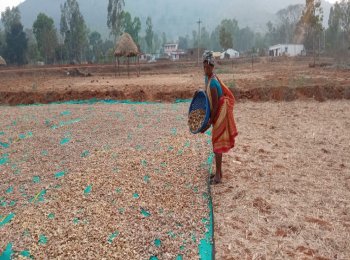
A group of women farmers in the Pottangi and Semiliguda blocks of Odisha’s Koraput district are marketing ginger and doing a good job of it! Here small farmers rely on tuber crops for their income and sustainability. However, marketing these crops has been a major challenge. Oxfam India partnered with Prastutee to initiate livelihood initiatives with support from the Sita Devi Malhotra Charitable (SDMC) Trust to address these issues.
Read More
26 Apr, 2023
Sitamarhi, Bihar
Spawning A Success Story In Parsauni Village
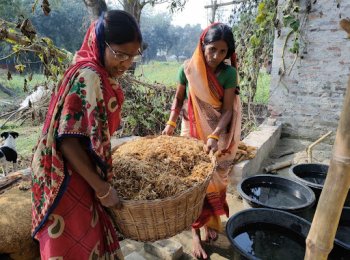
The Jeevan Jyoti Mushroom Utpadak Samuh consisting primarily of women from marginalised communities has made women entrepreneurs out of those women who once found it extremely difficult to make ends meet. Now they are nurturing business expansion plans, thanks to Oxfam India-HDFC Bank project Project Utthan.
Read More
17 Apr, 2023
Sitamarhi, Bihar
Anganwadi Centre No.115 Is Now A Model Centre
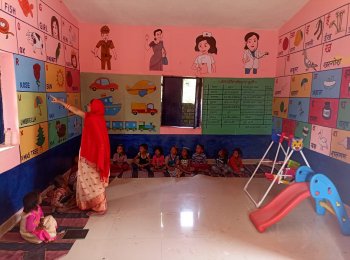
Project Utthan has had a significant impact on Anganwadi Centre No.115. Attendance has increased, and children now spend more time in the Centre; they are showing keen interest in learning with the new pictorial paintings and age-appropriate toys. Sushma is proud of her new renovated AWC. In fact, Sushma's presentations about the renovated AWC at various ICDS platforms have successfully drawn the attention of officials to the potential of replicating this model in other AWCs.
Read More
