


Oxfam India condemns sexual abuse of minors in shelter homes, demands justice
- By
- 10 Aug, 2018

Oxfam India condemns the brutal and repeated sexual abuse of minors in shelter homes in various states of India. Indian Government must provide immediate medical assistance, counselling and ensure safety of minor girls rescued from these homes.
Women, children and elderly who seek shelter at government-aided institutions are most vulnerable and can be easily exploited by those in power or running the facility. The incidents have exposed the lack of adequate monitoring processes for the government funded social schemes in India.
It is also the responsibility of civil society alliances to inform the authorities about any abuse or malpractices they witness in organisations working with women and children and to advocate for immediate punitive action by state government. The state government should ensure protection mechanisms for the whistleblowers in such cases.
Demands to the Government
Prolonged legal proceedings can be intimating and a threat to the safety of child survivors and witnesses. Government must ensure that the perpetrators are brought to justice through a swift and fair trial.
- A comprehensive grievance redressal system must be established in each state and at the central level involving different stakeholders to respond to women and child protection issues. It is evident that there was an absence of a coordination and accountability mechanism between different state departments in Bihar and Uttar Pradesh.
- Survivors should receive psychological counseling and medical support. The government must ensure safety and provide protection to minor survivors and witnesses.
- Regular social audits of the shelter homes and the schemes under which it functions must be conducted by an independent body.
- The Child Budget (including child protection budget) as a percentage of GDP has fallen from 0.7 percent in 2012-13 to mere 0.4 percent in 2018-19 in India. Whereas our neighboring country like Sri Lanka spends 6-7 percent of its GDP on children. Allocation to Child Budget should be increased to at least 5 percent of the GDP, so that schemes for children like ICPS* function effectively.
*ICPS- In order to reach out to all forms of excluded children, the Ministry of Women and Child introduced a revised Integrated Child Protection Scheme (ICPS) with Civil Society Partnership in 2014. ICPS aims to brings together multiple existing child protection schemes of the Ministry under one comprehensive umbrella, and integrate additional interventions for protecting children and preventing harm. Though the responsibility of ensuring effective implementation of the scheme rests with the state government, the central government has the primary responsibility of monitoring and tracking of the systems and procedures under the scheme.
Background:
At least 34 minor girls including a seven-year-old speech-impaired child were repeatedly raped and physically assaulted in a Muzaffarpur shelter home which received grant in aid from Bihar Government’s social welfare department. An audit was conducted by Tata Institute of Social Sciences of 110 government-run or supported institutions in the state that house a range of people such as old-age homes, children homes, adoption centres and rehabilitation centres of people into begging. The report revealed abuse of minor girls since 2013 at the government aided children’s home Seva Sankalp Evam Vikas Samiti. The report cited sexual exploitation at six short stay homes, physical abuse at 14 shelters, bathrooms with no latches, and inmates being “always locked up” and further said abuse is “prevalent in almost all institutions”.
The audit report was submitted by TISS on April 26 this year to the Bihar government. On May 31, the social welfare Department filed an FIR at the women’s police station in Muzaffarpur, seeking “suitable action” on the plight of girls as mentioned on page 52 of the TISS report under the caption ‘Grave Concern.’ A case was filed under Section 376 and 120B of the Indian Penal Code (IPC) and the Protection of Children from Sexual Offences (POCSO) Act against the NGO. 10 people have been arrested and one person is absconding.
Bihar Government has handed over the case to Central Bureau of Investigations (CBI).
Twenty-four girls were rescued from a shelter home in Deoria in Uttar Pradesh. Police have also made arrests of in the case after allegations of sexual exploitation of the inmates came to light. The shelter home, Ma Vindhyawasini Mahila Prakishan Evam Samaj Sewa Sansthan, had 42 inmates.
Uttar Pradesh Chief Minister announced that the investigation in the case would be handed over to the CBI and a 3-member SIT would also investigate the matter.
For media queries please contact Himanshi Matta, Media coordinator, 8860182310
Recent News
Related Stories
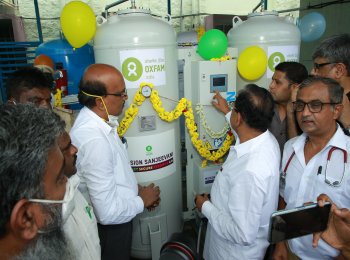
15 Aug, 2021
Tumkur, Karnataka
Oxfam India’s First Oxygen Plant in Tumkur
The 300 LPM Oxygen plant, set up under Oxfam India’s COVID-19 response ‘Mission Sanjeevani’, at the 80-bed government hospital at Koratagere in Tumkur in Karnataka will cater to people from 46 surrounding villages. Tumkur MLA, Dalit Leader and former deputy chief minister of Karnataka, G Parameshwara inaugurated the Oxygen plant on 26 July 2021.
Read More
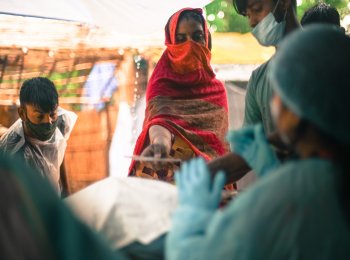
02 Aug, 2021
New Delhi
Delivering Hope and Dignity to Refugees
Oxfam India has been supporting communities worst affected by the pandemic, across India, for over a year now. At the heart of our response are communities already living on the margins such as daily wage workers, transgender communities, informal sector workers and differently abled people. We partnered with HAI to extend our support to refugees from Pakistan living in Delhi.
Read More
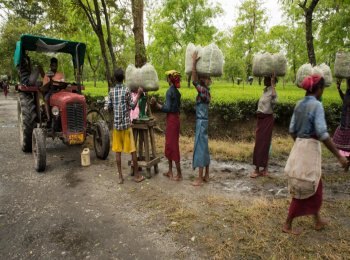
07 Jul, 2021
Assam
Labour Codes Training for Assam Tea Garden Workers
The Labour Codes will have significant impacts on the informal sector workers including the tea garden workers. A need was thus felt to train the workers around these Codes. The existing Plantation Labor Act, 1951 which used to govern the tea industry will be subsumed under these Codes. Different aspects of the Act will now feature in these four codes. In the above context, Oxfam India in collaboration with Centre for Workers’ Management initiated a training programme for workers across seven districts of Assam, during the month of June.
Read More
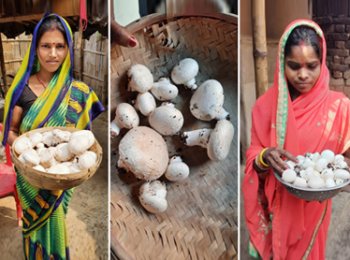
13 Apr, 2021
Sitamarhi, Bihar
Mushroom Cultivation Makes Communities Resilience
Oxfam India has been working with these communities through its disaster risk reduction programme since 2012. It was in 2017 that it finally started its livelihood intervention programme — mushroom cultivation and vermicomposting — with the women from the Musahar community. This proved useful during the lockdown in 2020.
Read More
