


2022 CRII: INDIA MOVES UP SIX PLACES IN INEQUALITY INDEX BUT CONTINUES TO BE AMONG LOWEST PERFORMERS IN HEALTH SPENDING.
- By Abhirr VP
- 11 Oct, 2022
In terms of spending on health, education and social security, India is performing the worst as compared to its neighbouring countries[i].
October 11, 2022; New Delhi: India has moved up six places to rank 123 out of 161 countries for reducing inequality in the latest Commitment to Reducing Inequality Index (CRII).
The 2022 CRII is the first detailed worldwide analysis published looking at governments’ policies and actions of 161 countries to fight inequality during the first two years of the COVID-19 pandemic. Norway leads the CRII followed by Germany and Australia. While India has moved up the rankings, India features among the lowest performers on health spending again; it has dropped a further two places in the rankings, to 157th, the 5th lowest in the world.
The Index which is prepared by Oxfam International and Development Finance International (DFI) measures governments policies and actions in three areas proven to have a major impact on reducing inequality. The three areas are public services (health, education, and social protection), taxation and workers’ rights.
“The 2022 CRII report shows India making marginal gains when it comes to reducing inequality during the COVID-19 pandemic. India which was ranked 129 in the previous index in 2020 has moved up six places mainly due to indicators quantifying impact of public spending and impact of tax on reducing inequality. These are the positives from the report but what’s worrying is that India is still lagging when it comes to spending on health, education and social security” said Amitabh Behar, CEO of Oxfam India.
“India unfortunately features among the lowest performers on health spending again. India has dropped a further two places in the rankings, to 157th (or 5th lowest in the world). India even made small cuts on health spending between 2019 and 2021 – at a time of unprecedented health need and crisis. Given the wide criticism of the government’s response to COVID-19 and the great need for healthcare improvements, it is disappointing to see that things are still moving in the wrong direction”, said Amitabh Behar.
India’s health spending is 3.64% of total spending. This is the lowest out of all BRICS and neighbouring countries. While China and Russia are spending 10%, Brazil is at 7.7% and South Africa is highest at 12.9%[ii]. Even in neighbouring countries, Pakistan is at 4.3%, Bangladesh at 5.19%, Sri Lanka at 5.88% and Nepal at 7.8%.
The 2022 CRII shows that despite the worst health crisis in a century, half of low and lower middle-income countries in the Index, cut the share of health spending of their budgets. Half of all countries (77) cut the share going to social protection, while 70% cut the share going to education[iii].
While poverty levels increased to record levels and workers struggle with decades-high prices, two thirds of countries failed to raise their minimum wages in line with economic growth during the pandemic. Twelve countries in the Index have no national minimum wage – with India joining this list since 2020. India has been reclassified as not having a minimum wage, given that a large number of workers, like domestic workers in many states, are not covered by minimum wages.”
Despite huge pressure on government finances, 143 of 161 countries froze the tax rates on their richest citizens, and 11 countries even lowered them.
“Our index shows that most governments have completely failed to take the steps needed to counter the inequality explosion created by COVID-19. They ripped away public services when people needed them most, and let billionaires and big corporations off the hook as they reap profits at record number” said Gabriela Bucher, Oxfam International’s Executive Director.
KEY FINDINGS OF CRII 2022:-
1: India’s overall rank has improved by 6 points from 129 in CRI 3 to 123.
2: It has moved up 12 places to rank 129 for reducing inequality through progressive spending and three places to rank 16 for progressive taxation. The rank for labour rights has remained the same.
3: Under Impact of public spending on reducing inequality indicator, India has moved up 27 places.
4: Under Impact of tax on reducing inequality indicator, India has moved up 33 places.
5: Under ranking for minimum wage, India has fallen 73 places due to India being reclassified as not having a national minimum wage.
COMPARISON WITH OTHER COUNTRIES:-
1: India is way behind the other BRICS countries. Of the five, South Africa is ahead at rank 27, followed by Russia with rank 36, China at 50, Brazil at 77 and India trailing far behind at 123.
2: Even in pillars like progressive spending, India is on rank 157, fifth from the bottom, while Brazil, China, Russia and South Africa are at ranks 89, 60, 62 and 43, respectively.
3: Among India’s neighbouring countries, only Pakistan has a slightly worse rank at 126 (3 ranks behind India), Bangladesh is at 107 (16 ranks ahead), Sri Lanka at 111 (12 ranks ahead) and Nepal at 112 (11 ranks ahead).
4: In terms of spending on health, education and social security, India is performing the worst as compared to its neighbouring countries. Sri Lanka is a close second at rank 156, Nepal at 154, Pakistan at 149 and Bangladesh at 136.
Download the latest CRII report here:- https://www.oxfamindia.org/knowledgehub/workingpaper/commitment-reducing-inequality-index-crii-2022
[i] As per CRII 2022; India from national budget documents; Bangladesh, Nepal and Sri Lanka from GSW; Pakistan from UIS, GSW and ILO
[ii] As per CRII 2022; Brazil data taken from CEPAL, China and Russia from WHO, South Africa from GSW
[iii] Compiled from various sources for each country by CRII
For any query, please reach out to - abhirr@oxfamindia.org
About Oxfam India
Oxfam India is a movement of people working to end discrimination and create a free and just society. We work to ensure that Adivasis, Dalits, Muslims, and women and girls have safe violence-free lives with freedom to speak their minds, equal opportunities to realize their rights, and a discrimination-free future.
Recent News
Global Hunger Index: Govt Living In Denial
18 Oct, 2021
Pandora Papers: Oxfam India Responds
04 Oct, 2021
First Oxygen Plant Inaugurated in Tumkur, Karnataka
27 Jul, 2021
Living Wages for Tea Plantation Workers
09 Jul, 2021
Related Stories
29 Mar, 2023
Koraput, Odisha
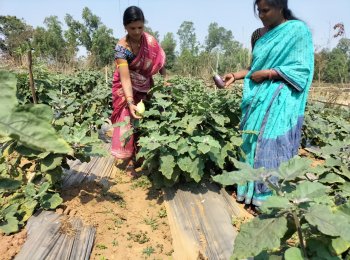
Women Farmers of Koraput Make Brinjal Cultivation Profitable
Jani Nayak, Namita Pujari and Sunita Pujari are breaking new grounds. The three women farmers have learnt brinjal grafting, implemented it in their field and are earning better profits and have reduced their input costs. This is unique because farmers in tribal pockets like Koraput had never experimented with brinjal grafting in the past. In fact the seedlings of the grafted brinjal was available only in neighbouring Chhattisgarh.
Read More
29 Mar, 2023
Nalanda, Bihar
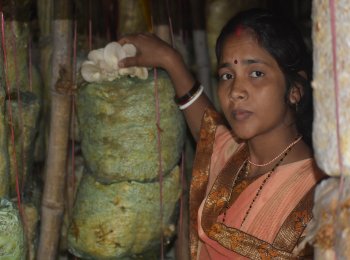
Mushroom Cultivation: Making The Most Of Cash Transfers
Conditional cash transfers was one of the components of the project and Rinku Devi was one of the community members who received Rs 12000 in March 2021. Armed with cash and technical knowhow of mushroom cultivation, Rinku decided to set up a 450 square feet mushroom production unit on her land.
Read More
24 Mar, 2023
Sitamarhi, Bihar
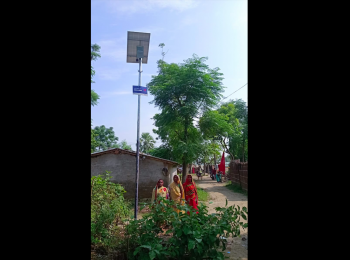
Solar Street Light: Reducing Carbon Footprint and Making Streets Safe
The unlit streets made the returning residents vulnerable to animal attacks. A VDC member told us that her children’s safety was a concern since they returned home at night after tuitions. The issue of lighting, especially in the streets, needed a solution. Under Project Utthan, an Oxfam India-HDFC Bank CSR initiative, 10 solar street lights were installed in the village.
Read More
23 Mar, 2023
Odisha
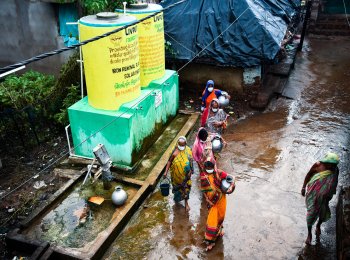
Making Clean Drinking Water Accessible
Access to clean drinking water is not as simple as it seems. It is a fundamental right yet many have no access to basic clean drinking water. This World Water Day calls for Accelerating Change. Amalin Patnaik and Savvy Soumya Misra write how simple innovations like the Iron Removal Plant is providing access to clean drinking water to coastal communities in Odisha.
Read More
