


Covid-19 Second Wave: The Need to Provide Immediate Relief & Ensure Social Protection for Informal Sector and Migrant Workers
- By Oxfam India
- 01 May, 2021
“In the second wave, ensuring access to quality public health is imperative. But in the backdrop of the current crisis, where the livelihood of informal workers has been hit the hardest, it is pertinent, now more than ever, to implement the protective social security measures for the 450 million informal workers,” says Amitabh Behar, CEO Oxfam India.
The second wave of the COVID-19 pandemic is more severe and deadlier than the first and the country is witnessing a complete collapse of the healthcare system. The poor are once again being pushed further into uncertainty and abject poverty. In this wave not only are they bearing the brunt of a failed healthcare system, but they are also going to face the massive economic strain.
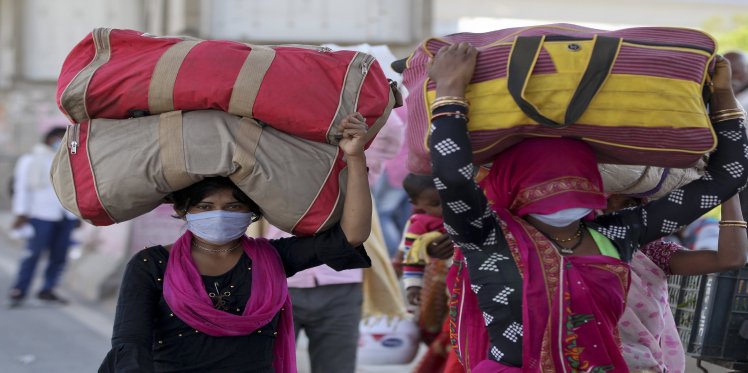
Though Prime Minister Narendra Modi in his address to the nation said that, ‘a nation-wide lockdown will be the last resort’, the sporadic curfews and lockdowns have triggered the exodus of informal sector migrant workers from cities to their villages once again.
According to the Ministry of Labour and Employment, in the first wave after the lockdown was announced on 24 March 2020, 1.23 crore informal sector migrant workers returned to their home states. Thousands of workers walked hundreds of kilometres to reach home; the lockdown left them without money, food, or jobs. Many lost their lives on the way back home.
Though the government announced a Rs 20,000 crore Atmanirbhar package in May last year for farmers, cottage industries, MSMEs, labourers, and middle class, there was very little in it for the migrant and informal sector workers. In the last few months and even in the budget for that matter, have not seen an immediate response for the informal sector workers. There are 45 crore informal sector workers in the participating labour force.
Many migrants did return to the destination states for work during last year and earlier this year. A recent study by ICRIER in collaboration with the Inferential Survey Statistics and Research Foundation (ISSRF) shows that although the migrant’s household income has increased after remigration to their destination places, there is still a contraction of 7.7 per cent in their income relative to the pre-lockdown level. Another lockdown will upset the momentum of recovery. If migrants decide to return to their native place, as many already have, their household income could drop by more than 80 per cent, a repeat of 2020.
It is evident that the second COVID-19 wave will leave a huge economic dent on the informal sector migrant workers. While we acknowledge the Atmanirbhar package, Oxfam India strongly believes that there is an urgent need to streamline the ongoing social security schemes to support the informal sector migrant workers.
From immediate cash transfer to free health services, from ensuring uninterrupted Public Distribution to providing MGNREGA work (once the migrants return) are some of the ongoing schemes, which if well implemented can bring relief to informal and migrant workers.
Given the health and humanitarian crisis we are in, these are the first few immediate measures that the Central and State governments should take:
• Tracking of all returnee migrants in their source states: This requires coordination between Labour, Health and Social Welfare Departments to function together. With the record available the government can assess their needs and provide them COVID testing free of cost and on priority.
• Immediate cash transfer of INR 5,000: This will help returnee migrants and informal workers who have lost their jobs during the second wave.
• Arrange isolation centres: These should be set up for all returnee migrant workers with adequate supplies of food and water, and proper provision of electricity and gender-segregated toilets.
• Adequate and safe shelter facility: This will ensure that those workers who have to stay back at their worksites till they get any transport facility to return or adequate budget to afford transport cost, are safe.
• Strengthen violence services in the states: Reports from last year showed a spike in domestic violence cases and cases of harassment of women and girls who were in transit or stranded at workplaces. The state should extend services to respond to such violence and widely circulate information related to crisis helpline numbers and strengthen service providers through government-civil society collaboration.
As intermediate and long term measures, the government should:
Provide uninterrupted universal coverage of the Public Distribution Centre: Families will be rendered without jobs and money and this step is key to ensure food security to the most marginalised and vulnerable. Those without ration cards should be included as well. Food and nutrition supplements should be made available for children and pregnant mothers at Anganwadi centres. Since National Disaster Management Act is in force schools are required to take the migrant children in. In West Bengal, government schools are distributing dry food ration to children of the age group of 6–14 years once in a month. This scheme should be introduced in states where migrants and their families are returning, making their children eligible for the same.
Uninterrupted continuation of social security pension schemes: Widow pensions and senior citizen schemes should continue unabated and the government should set up a functional helpline number with designated persons/teams at the block, panchayat and municipality levels.
Increase allocation to MGNREGS: Allocation for MGNREGS should be enhanced from Rs 73,000 Cr to Rs 1,50,000 Cr so that the migrant returnees are absorbed in rural employment. This will save a large number of migrant workers from the poverty trap and food insecurity.
Create a database of migrant and informal sector workers: This should be through a decentralised governance system and should have gender-disaggregated data along with caste and age information. We propose a Panchayat and Municipality wise database of migrant and informal workers which will help in assessing their requirements.
“In the last year, we have learnt how ‘powers to panchayats’ practised by Odisha resulted in an excellent management of COVID-19. Jharkhand Government had set up a Migration Collab in collaboration with Civil Society Organizations which tracked and supported migrants from Jharkhand in various other states. A database will help frame actions in favour of informal sector workers and migrants,” says Ranjana Das, Lead, Private Sector Engagement.
“In the second wave, ensuring access to quality public health is imperative. But in the backdrop of the current crisis, where the livelihood of informal workers has been hit the hardest, it is pertinent, now more than ever, to implement the protective social security measures for the 450 million informal workers,” says Amitabh Behar, CEO Oxfam India.
For more details contact:
Savvy Soumya Misra: +91 98187 79535
Tejas Patel: +91 99991 05600
📢Oxfam India is now on Telegram. Click here to join our Telegram channel and stay tuned to the latest updates and insights on social and development issues.
Recent News
Related Stories
18 Mar, 2021
Mumbai
Sewing A Better Future
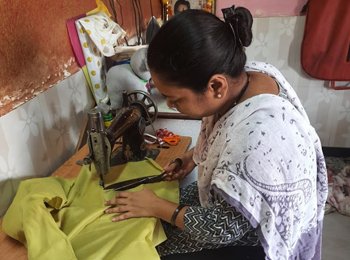
In Mumbai, livelihood trainings are being carried out among 12 SHGs in Govandi and Mankhurd. Despite the economy opening up, many have still not been able to either get their jobs back or restore the wages that they were getting pre-pandemic. The situation is worse for those who lost their sole breadwinners to the virus. Here's a story of 3 women who have been able to make ends meet, thanks to the livelihood training they received. These trainings are being done in collaboration with Siemens.
Read More
10 Mar, 2021
Mayurbhanj, Odisha
Youth Volunteer As Teachers During Pandemic
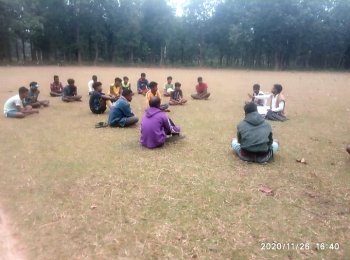
Last year, the sudden lockdown led to the closure of more than a million schools throughout the country leading to disruption in education of school students. While children everywhere faced the impact of this discontinuity of their education, the situation proved to be more severe for children from remote rural areas who had no access to internet, smartphone or electricity to be able to access virtual classes. This problem was further exacerbated for tribal students who further faced the challenge with regard to the language of instruction used for classes that were being broadcast. This situation prompted the Dharamveer Youth Group from Prasan Chandrapur Village of Noto Panchayat to come forward and take the responsibility of supporting children from the community so that they could continue their education.
Read More
14 Feb, 2021
Chhattisgarh & Jharkhand
Solar Boost For Rural Livelihood
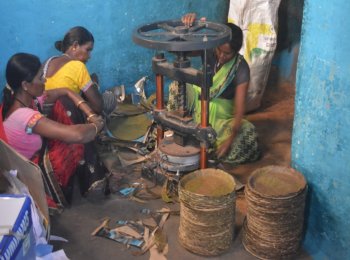
Based on the success of the solar-powered Sal leaf plate making unit in Chhattisgarh, two more machines were installed in Jharkhand and Chhattisgarh. This value addition will improve the quality of the product and fetch better price than the traditional hand-made plates. These have been set up in Bade Gobra village in Mainpur block in Chhattisgarh's Gariaband district and in Mohanpur Village in Sundarpahari Block in Jharkhand's Godda district.
Read More
11 Feb, 2021
Kushinagar, Uttar Pradesh
Making Toilets Sustainable
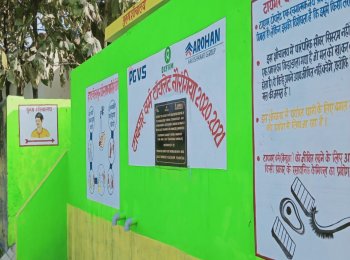
On February 2, 2021, Oxfam India handed over a Tiger Worm Toilet (TWT) complex to the Naurangiya panchayat in Uttar Pradesh’s Kushinagar district. Present at the handing over were community members and representatives from the Arohan Foundation and our on-ground partner PGVS. The toilet complex has five toilets and is built in the complex of the panchayat bhawan.
Read More
