


#TimeToCare (India)
- By Oxfam India
- 16 Jan, 2020
Total wealth of 63 Indian billionaires higher than last year’s Union Budget of India 2018-2019
The combined total wealth of 63 Indian billionaires is higher than the total Union Budget of India for the fiscal year 2018-19 which was at INR 24,42,200 crore, revealed a new report from Oxfam today ahead of the World Economic Forum (WEF) in Davos, Switzerland.
The world’s 2,153 billionaires have more wealth than the 4.6 billion people who make up 60 percent of the planet’s population, the report also showed.
“Our broken economies are lining the pockets of billionaires and big business at the expense of ordinary men and women. No wonder people are starting to question whether billionaires should even exist,” said Oxfam India CEO Amitabh Behar, who is in Davos to represent the Oxfam confederation this year.
Oxfam’s report, ‘Time to Care’ along with India focussed supplement, shows how our sexist economies are fuelling the inequality crisis —enabling a wealthy elite to accumulate vast fortunes at the expense of ordinary people and particularly poor women and girls:
- The top 1% of Indians hold more than 4 times the amount of wealth held by 953 million people (or the bottom 70% of the population).
- It would take a female domestic worker 22,277 years to earn what a top CEO of a Tech company makes in one year. With earnings pegged at INR 106 per second, the CEO would make more in 10 minutes than what the domestic worker would make in one year.
- Women and girls put in 3.26 billion hours of unpaid care work each and every day—a contribution to the Indian economy of at least INR 19 lakh crore a year; which is 20 times the entire education budget of India in 2019 (INR 93,000 crores)
- Direct public investments in the care economy of 2% of GDP would potentially create 11 million new jobs. This would make up for the 11 million jobs lost in 2018.
Global inequality is shockingly entrenched and vast and the number of billionaires has doubled in the last decade, despite their combined wealth having declined just in the last year.
“The gap between rich and poor can't be resolved without deliberate inequality-busting policies, and too few governments are committed to these,” Behar said.
“Women and girls are among those who benefit least from today’s economic system. They spend billions of hours cooking, cleaning and caring for children and the elderly. Unpaid care work is the ‘hidden engine’ that keeps the wheels of our economies, businesses and societies moving. It is driven by women who often have little time to get an education, earn a decent living or have a say in how our societies are run, and who are therefore trapped at the bottom of the economy,” added Behar.
Women do more than three-quarters of all unpaid care work. They often have to work reduced hours or drop out of the workforce because of their care workload. Across the globe, 42 percent of women cannot get jobs because they are responsible for all the caregiving, compared to just six percent of men.
Women also make up two-thirds of the paid ‘care workforce’. Jobs such as nursery workers, domestic workers, and care assistants are often poorly paid, provide scant benefits, impose irregular hours, and can take a physical and emotional toll.
The pressure on carers, both unpaid and paid, is set to grow in the coming decade as the global population grows and age. Climate change could worsen the looming global care crisis —by 2025, up to 2.4 billion people will live in areas without enough water, and women and girls will have to walk even longer distances to fetch it. 80 percent of indigenous people live in Asia and the Pacific, a region vulnerable to climate change.
The report shows governments are massively under-taxing the wealthiest individuals and corporations and failing to collect revenues that could help lift the responsibility of care from women and tackle poverty and inequality.
At the same time, governments are underfunding vital public services and infrastructure that could help reduce women and girls’ workload. For example, investments in water and sanitation, electricity, childcare, healthcare could free up women’s time and improve their quality of life.
“Governments created the inequality crisis —they must act now to end it. They must ensure corporations and wealthy individuals pay their fair share of tax and increase investment in public services and infrastructure. They must pass laws to tackle the huge amount of care work done by women and girls, and ensure that people who do some of the most important jobs in our society —caring for our parents, our children and the most vulnerable— are paid a living wage. Governments must prioritize care as being as important as all other sectors in order to build more human economies that work for everyone, not just a fortunate few,” said Behar.
Notes to editors
Download ‘Time to Care’, a methodology document outlining how Oxfam calculated the statistics in the report and the dataset. Also download India Supplement which provides detailed information about India.
Oxfam’s calculations are based on the most up-to-date and comprehensive data sources available. Figures on the share of wealth come from the Credit Suisse Research Institute’s Global Wealth Databook 2019. Figures on the very richest in society come from Forbes’ 2019 Billionaires List. Billionaire wealth fell in the last year but has since recovered.
Oxfam is part of the Fight Inequality Alliance, a growing global coalition of civil society organizations and activists that will be holding events from 18-25 January in 30 countries, including India, Kenya, Mexico, Pakistan, South Africa, Uganda and the UK, to promote solutions to inequality and demand that economies work for everyone.
READ GLOBAL PRESS RELEASE HERE
For media queries please contact:
Media Lead, Himanshi Matta
91-8860182310
himanshi@oxfamindia.org
Recent News
Related Stories
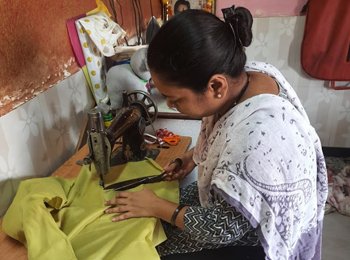
18 Mar, 2021
Mumbai
Sewing A Better Future
In Mumbai, livelihood trainings are being carried out among 12 SHGs in Govandi and Mankhurd. Despite the economy opening up, many have still not been able to either get their jobs back or restore the wages that they were getting pre-pandemic. The situation is worse for those who lost their sole breadwinners to the virus. Here's a story of 3 women who have been able to make ends meet, thanks to the livelihood training they received. These trainings are being done in collaboration with Siemens.
Read More
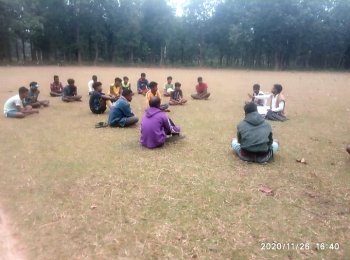
10 Mar, 2021
Mayurbhanj, Odisha
Youth Volunteer As Teachers During Pandemic
Last year, the sudden lockdown led to the closure of more than a million schools throughout the country leading to disruption in education of school students. While children everywhere faced the impact of this discontinuity of their education, the situation proved to be more severe for children from remote rural areas who had no access to internet, smartphone or electricity to be able to access virtual classes. This problem was further exacerbated for tribal students who further faced the challenge with regard to the language of instruction used for classes that were being broadcast. This situation prompted the Dharamveer Youth Group from Prasan Chandrapur Village of Noto Panchayat to come forward and take the responsibility of supporting children from the community so that they could continue their education.
Read More
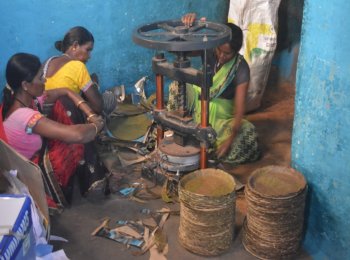
14 Feb, 2021
Chhattisgarh & Jharkhand
Solar Boost For Rural Livelihood
Based on the success of the solar-powered Sal leaf plate making unit in Chhattisgarh, two more machines were installed in Jharkhand and Chhattisgarh. This value addition will improve the quality of the product and fetch better price than the traditional hand-made plates. These have been set up in Bade Gobra village in Mainpur block in Chhattisgarh's Gariaband district and in Mohanpur Village in Sundarpahari Block in Jharkhand's Godda district.
Read More
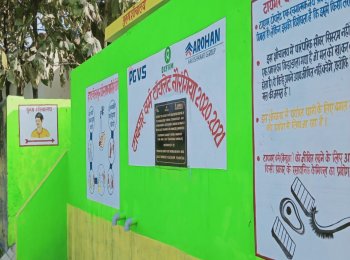
11 Feb, 2021
Kushinagar, Uttar Pradesh
Making Toilets Sustainable
On February 2, 2021, Oxfam India handed over a Tiger Worm Toilet (TWT) complex to the Naurangiya panchayat in Uttar Pradesh’s Kushinagar district. Present at the handing over were community members and representatives from the Arohan Foundation and our on-ground partner PGVS. The toilet complex has five toilets and is built in the complex of the panchayat bhawan.
Read More
